Drupal redesign
Drupal website redesign: rebuild without losing what matters.
From Drupal 7, 9 or 10, or from another CMS, to Drupal 11: a redesign that improves the experience for visitors and editors, preserves your search rankings and carries your content over without disruption.
Why redesign
Three reasons to redesign, rarely just one at a time.
Your site no longer reflects your brand or your offer, and its journeys no longer convert. Your editorial teams spend more time working around the back office than producing content. Your platform runs on a Drupal version that is no longer maintained, or on another CMS that has reached its limits: Drupal 7 has been unsupported since 5 January 2025, Drupal 10 will be after 9 December 2026.
A redesign addresses all three at once: a rethought experience, a content model and back office designed for the people who use them, an up-to-date Drupal 11 core. When only the version is the problem, an upgrade is enough; we say so during scoping rather than selling a redesign.
What a redesign changes
A redesign that serves both your audiences.
A better visitor experience
Journeys rethought from real usage, a fast, accessible site that reads well on every screen, search optimisation built from the content model up.
A better editor experience
A back office organised by workflow, clear forms, modular authoring that gives editorial teams control of their pages without technical skills.
A core ready for what comes next
Drupal 11, technical debt cleared, an architecture that can move to decoupling with Next.js or host AI agents without another redesign.

A controlled migration
Change the site without breaking what exists.
An audit of the existing site first
Inventory of content, content types and modules, measurement of technical debt, list of the URLs that bring traffic, map of the integrations with your IS. Scoping is based on what is, not on what we assume.
A content model redesigned, not copied
The redesign is the opportunity to simplify: content types, fields and taxonomies are redefined from editorial needs and target journeys, then documented. What no longer serves is not migrated.
A tooled and verified content migration
Content is carried over by replayable migration scripts, from Drupal or from another CMS, with explicit transformation rules. Each batch is checked on a staging environment before the switch.
Search rankings preserved
301 redirect plan built from the URL inventory, metadata and tags carried over, structured data, sitemap and Search Console monitoring after launch. A redesign must not cost a year of rankings.
A switch without downtime
Documented test and production environments, release checks passed before go-live, content freeze kept to the strict minimum, final migration replayed on the day, and a three-month warranty after launch.
Modular authoring
Pages built by your teams, faithful to the delivered design.
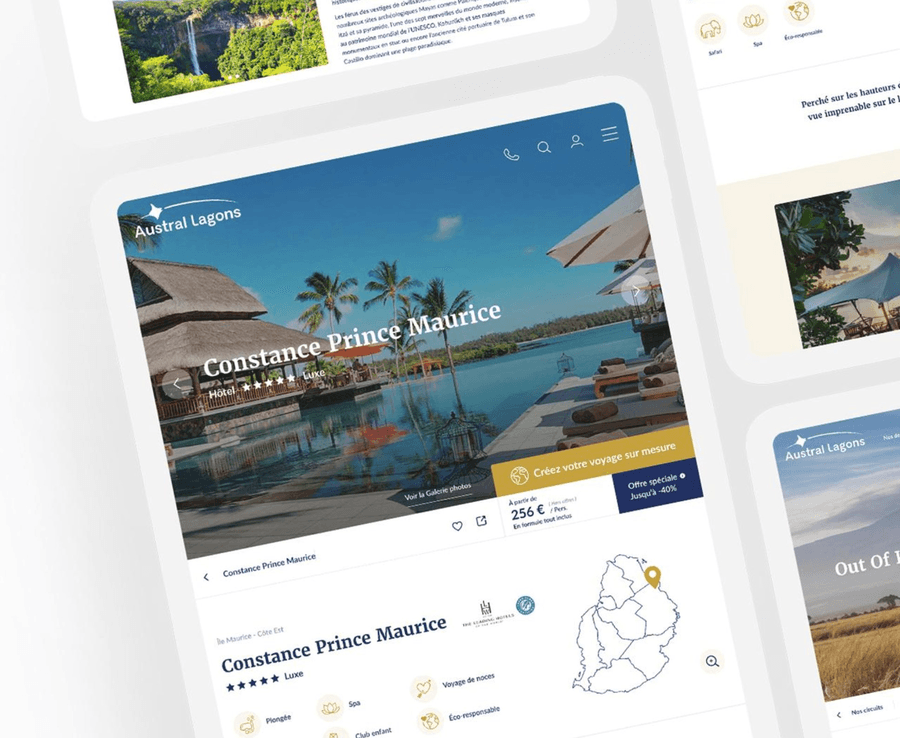
Our redesigns replace fixed templates with modular authoring: editorial teams compose their pages from blocks designed together with the design, without ever leaving the visual framework.
An ergonomic page builder
Preconfigured editorial blocks, dragged and ordered freely, with a rendering that matches the approved design.
A library of reusable components
Headings, text, lists, media, FAQs, callouts, forms, calls to action, organised into sections, blocks and components (atomic design).
Controlled freedom
Real-time preview in Drupal, reuse of blocks from one content item to another without losing structure, page variants per visitor profile.
An interface designed for editorial teams
Validation workflows, required and conditional fields, contextual help, clear forms: no technical skills required.

The method
Scoping, sprints, continuous acceptance.
Scoping led by the production director
A functional workshop on content, a persona and journey workshop, UX then UI workshops with design iterations, technical scoping: data model, migration, integrations. The scope and the schedule come out of this, not from a remote estimate.
Two-week sprints, visible throughout
Integration, front and back development, migration: each sprint is delivered to a staging environment where your teams test as they go, with a weekly check-in and a monthly project committee.
A validated launch, then support
Go-live is validated by your acceptance testing, after our release checks. Three months of warranty follow, then the platform joins our Drupal maintenance if you wish.
Frequently asked questions
Drupal redesign: your questions.
Redesign or upgrade?
An upgrade keeps the site as it is and updates its core (for example Drupal 10 to 11). A redesign rethinks the experience, the content model and the back office, and updates the core along the way. If your site suits you and only the version is a problem, an upgrade is enough: that is what we recommend in that case.
We are still on Drupal 7. What should we do?
Drupal 7 has been unmaintained since 5 January 2025: no security fixes are published any more. Moving to Drupal 11 is a migration, not an update: the content model is rebuilt and content is carried over by scripts. It is the typical case where a redesign costs barely more than a like-for-like migration, for a much better result.
What about Drupal 10?
Security support for Drupal 10 ends on 9 December 2026. The move to Drupal 11 is an update, prepared by a module compatibility audit. It can be done on its own, as part of maintenance, or as part of a redesign.
Can we migrate to Drupal from another CMS?
Yes. From WordPress, Joomla, a proprietary CMS or a static site, content is extracted, transformed and imported by migration scripts, with the same checks as a Drupal migration. The target content model is designed for Drupal, not copied from the old tool.
Will we lose our search rankings?
Not if the redesign plans for it from scoping: inventory of the URLs that bring traffic, 301 redirect plan, metadata carried over, structured data, sitemap, and ranking monitoring after launch. The redesigns that lose traffic are those that deal with SEO afterwards.
Who migrates the content?
We do, with replayable scripts, from transformation rules defined with you. Your teams handle what cannot be automated: deciding what is dropped, enriching key content, testing batch by batch on the staging environment.
Should we go headless as part of a redesign?
Not necessarily. For a mostly editorial site, Drupal alone often remains the simplest and most economical choice. Decoupling with Next.js makes sense when experience, multi-site or business data integration become central. We decide during scoping, and a well-designed Drupal 11 core allows decoupling later.
How long does a redesign take?
It depends on the scope, the volume of content to migrate and the integrations. Scoping produces a sprint schedule and a budget; we do not give a duration before having done it.
Client experience
A partner engaged at every step
Discover how we support our clients, from strategy to production — a genuine human collaboration.
Discover the Neovia client experience→What digital experience for your customers?
Let's talk about your needs. We'll show you how we can support you throughout your project.
Get in touch